
Ai laptop (mobile workstation)
For years, serious AI development meant sitting in front of a full-tower desktop packed with massive GPUs.
That is no longer strictly true. The rise of NPU-equipped processors (Intel Core Ultra, AMD Ryzen AI) and increasingly powerful mobile GPUs means that developers can now prototype, fine-tune small models, and run local inference from a laptop at a coffee shop, on a plane, or in a client meeting.
But here is the critical distinction that laptop marketing deliberately blurs: having an “AI PC” badge on the box does not mean the laptop can actually train deep learning models.
A Neural Processing Unit (NPU) and a discrete GPU (dGPU) serve fundamentally different roles in AI development.
This guide cuts through the marketing to help you find the right mobile workstation for real AI engineering work.
NPUs vs. Discrete GPUs for Developers
Understanding this distinction before you buy will save you from an expensive mistake.
What Is an NPU?
A Neural Processing Unit is a dedicated, low-power accelerator built directly into the CPU die. Intel’s Core Ultra processors include an NPU, and AMD’s Ryzen AI series integrates the XDNA 2 architecture NPU. These units are measured in TOPS (Trillion Operations Per Second) — current NPUs deliver 10-45 TOPS.
NPUs are designed for:
- On-device inference (Copilot, real-time transcription, background noise removal)
- Image enhancement and object recognition in photos/video
- Running small AI models (under 3B parameters) efficiently and with minimal power draw
NPUs are not designed for:
- Training neural networks
- Fine-tuning large language models
- Running models larger than a few billion parameters
- Any workflow that requires CUDA, cuDNN, or NVIDIA Tensor Cores
If your goal is to run Copilot features, summarize documents locally, or add smart assistants to your workflow, an NPU-equipped Copilot+ PC is sufficient and energy-efficient.
When You Need a Discrete GPU
If your workflow involves any of the following, you need a laptop with a discrete NVIDIA RTX GPU (not just an NPU):
- Fine-tuning language models (even 7B models with LoRA adapters)
- Running local inference on 13B+ models via Ollama, llama.cpp, or vLLM
- Training computer vision models (object detection, segmentation)
- Using PyTorch, TensorFlow, or JAX with CUDA acceleration
- Prototyping before deploying to a production workstation or server
Discrete laptop GPUs (RTX 4070, 4080, 4090 mobile) provide:
- 8-16 GB of dedicated VRAM
- CUDA and Tensor Core acceleration
- Compatibility with the full NVIDIA software stack
The key limitation is VRAM. Even the best laptop GPU (RTX 4090 mobile) provides only 16 GB of VRAM — far less than the 24 GB available in its desktop counterpart. This limits the maximum model size you can work with locally.
Objective Evaluation Criteria
When we evaluated mobile workstations for AI development, we did not just look at generic benchmarks. We assessed each system using the following strict criteria:
- Maximum VRAM Availability: Can the laptop be configured with at least 16 GB of dedicated VRAM?
- AI Software Ecosystem Compatibility: Does it support the NVIDIA CUDA ecosystem, or is the software stack relying on experimental patches?
- Thermal Performance vs. Throttle Output: How well does the laptop handle sustained inference loops over 30 minutes?
- Enterprise Utility: Is the system ISV certified, and does it support ECC memory for data safety?
Top Mobile Workstations for AI Engineers
Not all powerful laptops are created equal. Here are the systems that actually deliver for developers working on AI, organized by form factor and use case, followed by a comprehensive side-by-side comparison.
Thin and Light Powerhouses
These machines balance portability with real GPU horsepower, making them ideal for developers who travel frequently but still need to run local inference and fine-tuning experiments.
ASUS ROG Zephyrus G16
- CPU: Intel Core Ultra 9 or AMD Ryzen AI 9
- GPU: NVIDIA RTX 4080/4090 mobile (16 GB VRAM)
- RAM: Up to 32 GB DDR5
- Weight: ~4.4 lbs
- Why it matters: One of the lightest laptops available with a full RTX 4090 mobile GPU. The ROG Zephyrus G16 provides enough VRAM for 7B model fine-tuning and comfortable inference on quantized 13B-30B models.

- Ultra 9 + RTX 5070 Performance--The all-around gaming laptop is powered by an Intel Core Ultra 9 285H processor and NVIDIA GeForce RTX 5070 Laptop GPU, it is built for gaming, creative work, multitasking, streaming, and everyday productivity in a slim 16-inch design.
- 16" 2.5K OLED 240Hz Display--The 16-inch ROG Nebula OLED display delivers 2.5K resolution, 240Hz refresh rate, 0.2ms response time, 100% DCI-P3 color, Delta E < 1 accuracy, 500-nit brightness, NVIDIA G-SYNC, and VESA DisplayHDR True Black 500 support.
- Slim, Light, and Ready to Move--ROG Zephyrus G16 is designed for portable performance, this silm laptop features a premium Eclipse Gray chassis, measuring about 0.59 inches thin and 4.08 lbs. A 90Wh battery and fast-charge support make it suitable for work, travel, school, and gaming setups.
- ROG Intelligent Cooling--ROG Intelligent Cooling helps maintain stable performance with liquid metal, Tri-Fan Technology, 2nd Gen Arc Flow Fans, and 0dB Ambient Cooling, balancing thermal control for demanding games, content creation, and long multitasking sessions.
- Strong Connectivity and Immersive Audio--This notebook connects your full setup with HDMI 2.1, Thunderbolt 4 Type-C with DisplayPort 2.1 and Power Delivery 3.0, USB-A, USB-C, SD card reader, audio combo jack, and slim power jack. Six speakers, dual force-canceling woofers, Dolby Atmos, and Wi-Fi 7.
Razer Blade 16
- CPU: Intel Core Ultra 9
- GPU: NVIDIA RTX 4090 mobile (16 GB VRAM)
- RAM: Up to 64 GB DDR5
- Weight: ~5.4 lbs
- Why it matters: The Razer Blade 16 combines a stunning 16-inch display with the full RTX 4090 mobile and up to 64 GB of system RAM — a rare configuration that supports larger dataset preprocessing alongside GPU-intensive model work.

- ULTRA-THIN GAMING POWER — Take flagship performance anywhere with a 14.9 mm CNC aluminum design, delivering high-end gaming and creative power in a portable 16-inch laptop built for travel, work, and play
- NEXT-GEN INTEL PERFORMANCE — Run demanding AAA games and multitask effortlessly with Intel Core Ultra 9 386H (16 cores, up to 4.9 GHz) plus AI acceleration for gaming, streaming, and content creation
- NVIDIA RTX 5080 GRAPHICS — Experience smooth high FPS and realistic visuals with NVIDIA GeForce RTX 5080 (16GB GDDR7, up to 165W TGP), ideal for modern AAA titles, esports, and creative workloads
- 240HZ QHD+ OLED DISPLAY — 16" 2560×1600 OLED panel with 240Hz refresh rate, 0.2 ms response time, 16:10 aspect ratio, VESA DisplayHDR TrueBlack 1000 (up to 1100 nits), and 100% DCI-P3 Calman Verified color for gaming and content creation
- ADVANCED VAPOR COOLING — Push performance longer with vapor chamber cooling designed for improved thermal efficiency and sustained power during extended gaming or creative sessions

Enterprise Mobile Workstations
For developers working in regulated environments (healthcare, finance, government) who need ISV certifications, ECC memory, and enterprise support.
Dell Precision AI Mobile Workstation
- CPU: Intel Core Ultra or AMD Ryzen AI Pro
- GPU: NVIDIA RTX workstation-class (RTX A-series)
- RAM: Up to 128 GB ECC DDR5
- Weight: ~6 lbs
- Why it matters: Dell Precision laptops are ISV-certified for professional CAD and AI frameworks. The workstation-class RTX A-series GPU provides better driver stability for 24/7 inference workloads and ECC VRAM for data integrity.

- Intel Core i9-13950HX Processor for demanding professional applications and multitasking workloads. Includes Dell Manufacturer Warranty through March 2031.
- NVIDIA RTX 3500 Ada Generation: Featuring 12GB of VRAM, this professional-grade GPU delivers the stability and power required for advanced engineering, architectural design, and intensive content creation.
- Professional Workstation Configuration – Designed for engineering, design, software development, data analysis, and other business applications.
- Built for Business & Connectivity – Features HDMI, USB-C, Wi-Fi, Bluetooth, and Windows 11 Pro with AI Copilot for productivity, security, and modern workflows.
- ISV-Certified Workstation Performance – Optimized and tested for professional software applications used in design, engineering, and data science.
Lenovo ThinkPad X1 AI / ThinkPad P16 Gen 2
- CPU: Intel Core Ultra X7/X9
- GPU: Optional discrete NVIDIA GPU; integrated NPU for lighter tasks
- RAM: Up to 128 GB
- Why it matters: The ThinkPad P16 Gen 2 with an NVIDIA RTX A5500 is one of the most powerful mobile workstations available. For lighter, NPU-assisted workflows, the ThinkPad X1 AI offers excellent battery life and portability.
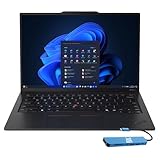
- Intel Core Ultra 7 258V, 8C (4P + 4LPE) / 8T, Max Turbo up to 4.8GHz, 12MB Intel Smart Cache
- 14" 2.8K (2880x1800) OLED 500nits Anti-glare / Anti-reflection / Anti-smudge, 100% DCI-P3, 120Hz VRR, DisplayHDR True Black 500, Dolby Vision
- 32GB LPDDR5X-8533, MoP Memory
- 1TB SSD M.2 2280 PCIe 4.0x4 NVMe
- Windows 11 Pro, Backlit Keyboard, Fingerprint Reader, WiFi+Bluetooth, 1-Year Warranty
Side-by-Side Mobile Workstation Comparison
| Feature / Laptop | ASUS ROG Zephyrus G16 | Razer Blade 16 | Dell Precision 7680 | Lenovo ThinkPad P16 |
|---|---|---|---|---|
| AI Performance Rating | ⭐⭐⭐⭐ | ⭐⭐⭐⭐⭐ | ⭐⭐⭐⭐ | ⭐⭐⭐⭐ |
| Max VRAM | 16 GB (RTX 4090) | 16 GB (RTX 4090) | 16 GB (RTX 5000 Ada) | 16 GB (RTX 5000 Ada) |
| Max RAM | 32 GB DDR5 | 64 GB DDR5 | 128 GB CAMM ECC | 128 GB ECC |
| Pros | Highly portable, Excellent cooling | Best RAM for a gaming laptop, Premium build | ISV Certified, Great support | High durability, Excellent keyboard |
| Cons | RAM is soldered and capped to 32 GB | High price and power drain | Heavy, thick chassis footprint | Expensive enterprise markup |
| Estimated Cost | ~$3,000+ | ~$4,000+ | ~$4,500+ | ~$4,500+ |
Trade-offs of Mobile AI Development
Knowing what a laptop can and cannot do prevents wasted money and frustrated expectations.
Battery Life and VRAM Limits
The single biggest limitation of mobile AI development is VRAM. Even the top-tier laptop GPU provides 16 GB — meaning you cannot train a 70B parameter model even with aggressive quantization. For any workload that exceeds this ceiling, you will need either a desktop workstation or cloud access.
Battery life is the other constraint. Running GPU-intensive AI workloads drains a laptop battery in 45-90 minutes. Realistically, GPU-heavy development happens while plugged in. Design your workflow accordingly — use the laptop on battery for coding, testing, and reviewing, and plug in for training runs.
The Hybrid Approach: Laptop + Remote Desktop
Many professional AI engineers use a hybrid workflow:
- Laptop (in the field): Write code, test prompts, run lightweight inference, review results
- Desktop workstation (at the office/home): Run full training, fine-tuning, and heavy inference
- SSH or Remote Desktop: Connect to the workstation from anywhere via VS Code Remote, JupyterHub, or SSH tunnels
This approach gives you the portability of a laptop with the raw power of a multi-GPU workstation. The laptop only needs enough local GPU to validate that your code runs correctly; the heavy lifting happens on the remote machine.
The eGPU Paradox: External GPUs for AI
Can you turn a thin-and-light laptop into an AI powerhouse using an External GPU (eGPU) enclosure like the Razer Core X or Akitio Node?
The answer is a qualified “maybe.”
- The Pros: You gain access to a desktop-class RTX 4090 with 24 GB of VRAM, which is impossible to find inside a laptop.
- The Cons: Thunderbolt 4 bandwidth is limited to ~32 Gbps, which is far slower than the ~512 Gbps of a native PCIe Gen 5 x16 slot.
- The Result: While your training epochs will be significantly slower than they would be on a native desktop, an eGPU allows you to load larger models that simply won’t fit in a mobile GPU’s 16GB VRAM. It is a cost-effective bridge for developers who aren’t ready to commit to a full workstation.
Optimizing the Mobile AI Workflow
Developing AI on the move requires more aggressive system tuning than standard software engineering.
Heat Management on the Road
Laptops are prone to thermal throttling during sustained inference runs. To keep your system at peak performance:
- Elevate the chassis: Use a simple laptop stand to improve bottom-intake airflow.
- Aggressive Fan Profiles: Use software like Armoury Crate (ASUS) or Razer Synapse to set “Turbo” or “Max” fan speeds before starting a local model download or evaluation run.
- Undervolting: For advanced users, undervolting the CPU can reduce heat output and prevent the GPU from being throttled by shared thermal pipes.
Battery Life Optimization
Running local models (Llama-3, Stable Diffusion) is the most power-intensive task a laptop can perform. To squeeze more time out of your battery:
- Quantization is Mandatory: Never run FP16 models on battery. Always use 4-bit (Q4_K_M) or 8-bit quantization to reduce GPU core utilization and memory bandwidth power draw.
- Limit Context Length: Reducing the model’s context window from 32k to 4k tokens significantly lowers the computational load per response.
- Brightness and Peripherals: Dimming the screen and disabling RGB lighting won’t save much compared to the GPU, but every watt counts when you’re 30 minutes from the nearest outlet.
Frequently Asked Questions
Is a Copilot+ PC good enough for an AI engineer?
A Copilot+ PC with only an NPU (no discrete GPU) is sufficient for running Microsoft Copilot features, local AI assistants, and very small model inference. It is not sufficient for training, fine-tuning, or running models larger than ~3B parameters. AI engineers who work with PyTorch or TensorFlow need a discrete NVIDIA GPU.
How much VRAM is available on the best AI laptops?
The maximum discrete GPU VRAM available in current laptops is 16 GB (NVIDIA RTX 4090 mobile). Some AMD Ryzen AI Max configurations offer up to 96 GB of unified memory that can be shared between CPU and GPU tasks — an emerging option for laptop-based LLM development.
Can I train deep learning models on a laptop?
You can train small to medium models (up to ~7B parameters with quantization) on a laptop with a discrete RTX GPU. For larger models, the VRAM and thermal constraints of a laptop make training impractical. Use the laptop for development and testing, and offload training to a workstation or cloud.
Should I choose a gaming laptop or a workstation laptop for AI development?
Gaming laptops (ROG, Razer Blade) typically offer better GPU performance and value. Workstation laptops (Dell Precision, Lenovo ThinkPad P) provide ISV certifications, ECC memory, and enterprise support. Choose a gaming laptop for independent work and a workstation laptop for enterprise environments.
Is macOS on Apple Silicon viable for AI development?
Apple M3 Max and M4 Max chips offer exceptional unified memory (up to 128 GB) and excellent performance for inference workloads. However, the CUDA ecosystem (which PyTorch and most ML tools rely on) is NVIDIA-only. Apple Silicon uses Metal and MPS backends, which have narrower framework support. For an NVIDIA-centric workflow, macOS is not the best choice. For inference-focused or lighter experimentation, it is competitive.
What is the minimum laptop spec for running local LLMs?
At minimum: a discrete NVIDIA GPU with 8 GB VRAM, 16 GB system RAM, and 512 GB SSD. This allows running quantized 7B models via Ollama. For comfortable development and iteration, target 16 GB VRAM, 32 GB RAM, and 1 TB SSD.
How important is the NPU for AI developers?
For most AI developers working with PyTorch and large models, the NPU is a minor feature — it offloads small background AI tasks but does not contribute to heavy ML workloads. It becomes valuable if you develop applications that specifically target on-device AI inference (edge AI, real-time vision, mobile deployment).
Does screen size and resolution matter for AI development?
A larger screen (15-16 inches) with high resolution (QHD or 4K) improves productivity when working with Jupyter Notebooks, data visualizations, and code editors side by side. Dual-monitor support via USB-C/Thunderbolt is also worth verifying for docked workflows.
Conclusion: Quick Selection Guide
The best AI laptop for developers depends entirely on your workload and work style. If you are stuck between models, use this quick checklist to finalize your decision:
- Traveling often and running local inference? Choose the ASUS ROG Zephyrus G16 or Razer Blade 16 with an RTX 4090 mobile. They give you the absolute peak of mobile GPU performance in a very portable form factor.
- Staying plugged into external monitors at the office? Go for a Dell Precision or Lenovo ThinkPad P16 Gen 2. They offer ISV certification, ECC memory, vendor support, and can handle sustained heavy workloads safely.
- Focused purely on Copilot integration and cloud-based engineering? Any modern Copilot+ PC with an NPU will handle the built-in AI assistant features efficiently, maximizing battery life.
For workloads that exceed what a laptop can handle — training large models, multi-GPU scaling, or continuous fine-tuning — pair your laptop with a dedicated AI development workstation or even build your own custom machine learning workstation and use a remote desktop workflow to get the best of both worlds.
VMinstall.com is a participant in the Amazon Services LLC Associates Program, an affiliate advertising program designed to provide a means for sites to earn advertising fees by advertising and linking to Amazon.com, Amazon.co.uk, Amazon.ca, and other Amazon stores worldwide. *Best Sellers last updated on 2026-10-08 at 17:20.

